
Vitanthor Oncology
CAR-T cell therapy in China
CAR-T is a form of cellular immunotherapy. Some products are approved in defined blood-cancer indications; other uses, including many solid-tumour programmes, remain clinical, investigational, or earlier research. Vitanthor helps families understand that distinction and prepare a case for specialist review. We do not decide who may receive CAR-T.
Last reviewed: 11 October 2026
As of October 2026 China’s NMPA has approved nine CAR-T products, one of them for a solid tumour (gastric cancer, June 2026). Approval permits marketing in China; it does not by itself mean a hospital offers the treatment to patients coming from abroad. Named products, indications, and dates are not listed on this page.
Additional CAR-T constructs and indications may be available only inside clinical trials. This page does not list specific trials; any trial named on this site appears only with a registry identifier.
Investigational programmes are not the same as approved commercial treatment.
Earlier-stage solid-tumour work should not be read as routine care.
New manufacturing or targeting approaches may be discussed in the scientific literature without being available as treatment.
CAR-T explained in under a minute
English narration59 seconds
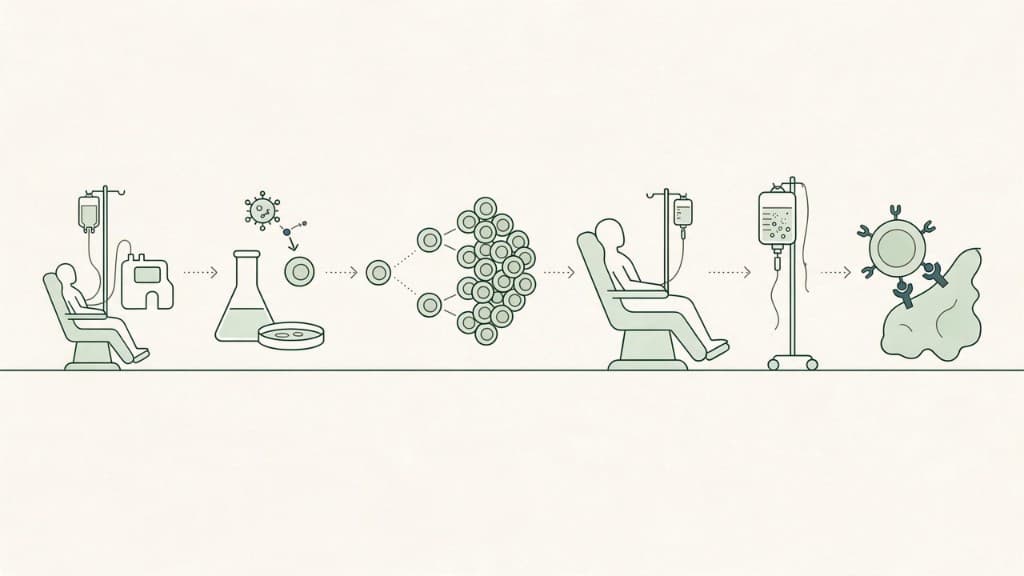
This short educational animation follows the CAR-T process at a high level: collecting a patient’s T cells, engineering a chimeric antigen receptor, expansion in the laboratory, and infusion. It illustrates general concepts only and does not depict any specific product, hospital, or treatment pathway.
The video is for educational purposes only. It is not medical advice, a diagnosis, or a treatment recommendation, and it does not indicate what any individual patient may be offered. Eligibility and treatment decisions belong with the treating specialist.
The animation is illustrative. Biological processes are simplified for clarity and may not reflect how any specific product, hospital, or individual case unfolds.
This educational animation includes AI-generated visuals. Biological processes are simplified for illustration.
What CAR-T is
CAR-T stands for chimeric antigen receptor T-cell therapy. In broad terms, a patient’s T cells — a type of immune cell — are collected, genetically instructed to recognise a marker on certain cancer cells, multiplied, and returned to the patient as a one-time or protocol-defined infusion.
CAR-T is not a single medicine. Different products target different antigens, use different manufacturing methods, and are studied or approved in different diseases. A result reported for one product and one indication should not be copied onto another.
How CAR-T works at a high level
A typical sequence, described in general educational terms, includes: confirming the diagnosis and target antigen where relevant; collecting T cells (often by apheresis — a procedure that draws blood and separates out one part, here the patient’s own immune cells, before returning the rest); manufacturing the CAR-T product; giving lymphodepleting chemotherapy (a short course of chemotherapy before the infusion, to reduce certain immune cells so the transferred cells can grow and work) in many protocols; infusing the product; and monitoring for acute toxicities such as cytokine release syndrome (CRS) and neurological effects (ICANS). Details vary by product and centre.
This summary is not a protocol, not a consent form, and not a substitute for a treating team’s explanation.
- Collection of the patient’s T cells
- Laboratory modification (transduction) so those cells can recognise a chosen antigen
- Manufacturing and quality checks
- Infusion and close observation
Cell collection

Blood is drawn and the T cells — a type of immune cell — are separated out; the rest of the blood is returned.
Gene added in the laboratory

A harmless viral vector carries the instruction for the chimeric antigen receptor into the patient’s T cells.
Cells grown
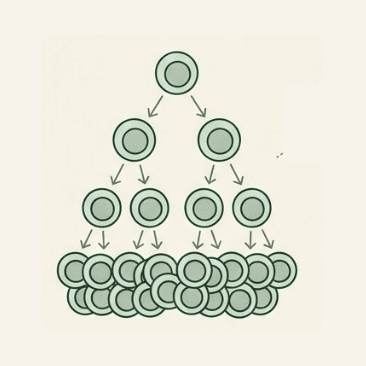
The modified cells are grown in the laboratory until there are enough for a dose — typically roughly two to eight weeks.
Preparatory chemotherapy

A short course of lymphodepleting chemotherapy is given before the infusion, to help the transferred cells grow and work.
CAR-T infusion
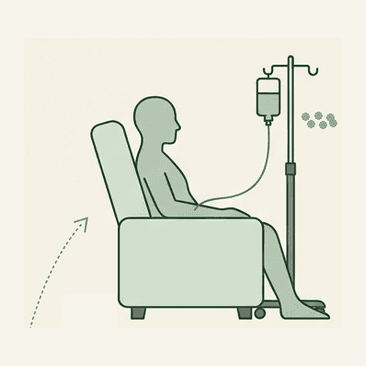
The finished CAR-T cells are returned to the patient through an intravenous drip.
Target binding
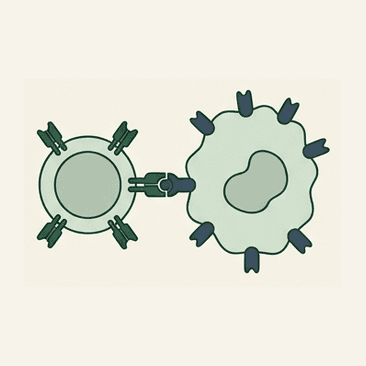
The modified T cells can then recognise and bind their target protein on cancer cells. Details vary by product and centre.
Approved CAR-T treatment pathways
Where a CAR-T product has been approved by China’s regulator, the NMPA, that approval applies to a defined indication — a specific disease, and often a specific line of treatment or patient group.
Vitanthor does not list product names, indications, or approval dates on this page. Approval in one blood cancer does not mean the same product is approved for another cancer.
Blood cancers
Much of the established CAR-T experience internationally has been in certain B-cell malignancies such as some forms of leukaemia and lymphoma, and in multiple myeloma — always within defined indications and after specialist assessment. In China, NMPA-approved indications cover defined forms of large B-cell lymphoma, B-cell acute lymphoblastic leukaemia and multiple myeloma; which pathway, if any, applies to a particular person must be confirmed with the treating team.
Not every person with a blood cancer is a candidate for CAR-T. Prior treatments, disease burden, organ function, infection risk, and social support all influence whether a team will offer it.
Solid-tumour CAR-T development
CAR-T for solid tumours (for example many cancers of the lung, liver, stomach, pancreas, or brain) is generally a more difficult scientific problem than CAR-T for some blood cancers. Barriers discussed in the literature include finding a safe target antigen, the tumour environment, and T-cell persistence.
Some groups in China and elsewhere are studying solid-tumour CAR-T in clinical trials. Those programmes are investigational unless a specific product has a stated regulatory approval for a defined solid-tumour indication. In June 2026 China’s NMPA approved the world’s first CAR-T for a solid tumour — a biomarker-defined subset of advanced gastric or oesophago-gastric junction cancer after at least two prior treatments — which is one indication in one country, not a general solid-tumour treatment. This page does not treat trial activity as approval.
How eligibility is assessed
Eligibility is assessed by the treating institution, not by Vitanthor. Teams typically review pathology, imaging, laboratory results, genomic or biomarker reports where relevant, prior therapies, performance status, and comorbidities.
A website cannot determine eligibility from a short description. If you have a patient-specific question — “Can I receive this?” — the appropriate next step is a Case Review so that records can reach a qualified team.
Typical patient journey
In general educational terms, an international patient journey may include: remote record review; a decision on whether an in-person evaluation is offered; travel and admission if appropriate; cell collection; a manufacturing interval; infusion; inpatient or closely supervised observation; and a plan for returning home. Timelines differ by product and centre and are not quoted here.
Important risks
CAR-T can cause serious, sometimes life-threatening toxicities. Widely discussed risks include cytokine release syndrome (CRS — widespread immune activity that causes fever and can affect blood pressure and organs), immune effector cell-associated neurotoxicity (ICANS — the brain and nervous system are affected, for example confusion, tremor or difficulty speaking), prolonged low blood counts, infections, and, less often, other immune or organ complications. Risk profiles differ by product and patient.
This list is not complete. A treating team should explain risks, monitoring, and what family members should watch for. Vitanthor will not minimise those risks in order to encourage travel.
Approved therapy versus clinical trial
An approved CAR-T pathway follows a licensed indication. A clinical trial follows a protocol, with inclusion and exclusion criteria, and the therapy is still being evaluated. Early findings from a trial are not the same as established clinical use.
Vitanthor labels these pathways separately. We will not convert preliminary trial observations into efficacy claims.
Treatment in China
Receiving care in China as an international patient involves medical, practical, and legal steps: institutional acceptance of the case, visa and travel, language, companion support, cost discussion with the institution, and a plan for complications. On visas: there is no dedicated medical-treatment visa for China — treatment falls under the S1/S2 “private affairs” routes, and only Hainan’s 30-day visa-free scheme includes medical treatment. Vitanthor can help coordinate communication and logistics. We do not operate the hospital.
We do not publish treatment prices, success rates, or waiting times. Those figures belong to the treating institution; where we ever cite cost research it will be a modelled estimate from a published study, clearly labelled as an estimate and never as a quote.
Returning home
After CAR-T, patients may still need close laboratory monitoring, infection precautions, and a plan for delayed toxicities. Continuity with the home oncology team matters. Vitanthor’s intended role is to help assemble a clear handover file — not to replace follow-up care in the patient’s own country.
Questions patients and families should ask
- 1
Is the pathway being discussed an approved indication, a clinical trial, or another investigational programme? Ask this first. An approved indication means a regulator — in China the NMPA — has authorised that product for that disease and line of treatment; a clinical trial follows a protocol that is still being evaluated; anything else is investigational or earlier research. The same therapy can be approved for one condition and investigational for another.
- 2
Which antigen does this CAR-T product target, and has my pathology shown that target? Ask which antigen the product targets — most approved CAR-T products target CD19 or BCMA, and since June 2026 one NMPA-approved product targets CLDN18.2 in a defined gastric-cancer indication — and whether your own pathology has shown that target. Only your treating team can read your pathology in this context.
- 3
What serious toxicities has this centre seen, and how are they treated on site? Ask directly what serious toxicities the centre has seen and how it manages them on site. FDA-approved CAR-T products carry boxed warnings for cytokine release syndrome (CRS), neurologic toxicity including ICANS, and secondary blood cancers, so a centre’s experience and its on-site capacity matter.
- 4
What happens if I am not eligible after I travel? Ask this before you book anything. No institution guarantees that a case will be accepted or that a person will remain eligible after in-person assessment; you should know in advance what happens to your records, what costs are already committed and what your options are if the answer changes. Vitanthor gives no travel or eligibility assurance.
- 5
How will my home oncologist receive records after I return? Ask how your home oncologist will receive the records after you return, in what format, and with your consent. Vitanthor’s intended role is to help assemble a clear handover file; continuity of follow-up care stays with your home team.
- 6
What costs are known, what is unknown, and who explains them to me in writing? Ask what is known, what is unknown and who will put the answer in writing before you commit. Published research gives modelled estimates rather than quotes — peer-reviewed research suggests treatment costs in China are substantially lower than in the United States — and several Chinese products have no published price at all, so only the treating institution can state your figure. Vitanthor charges patients no coordination fee.
- 7
Who is the responsible treating physician at the institution, not only a coordinator? Ask for the name of the responsible treating physician at the institution, not only a coordinator or agency contact, and how to reach that team during and after treatment. Clinical responsibility stays with a licensed professional and the institution that employs them.
- 8
Do CAR-T therapies work for solid tumours? Almost all approved CAR-T therapies are for blood cancers, and NCI still describes solid-tumour CAR-T as experimental. In June 2026 China’s NMPA approved the world’s first CAR-T for a solid tumour — a biomarker-defined subset of advanced gastric or oesophago-gastric junction cancer after at least two prior treatments — which is one indication in one country, not a general solid-tumour treatment. Every approved CAR-T carries boxed warnings for serious, potentially fatal side effects.
Sources & References
- CAR T-cell therapy — NCI Dictionary of Cancer Terms: T cells taken from the patient's blood, given the gene for a chimeric antigen receptor in the laboratory, grown in large numbers, and given by infusion; used to treat certain blood cancers and being studied for other cancers — National Cancer Institute (NIH) — link.
- CAR T Cells: Engineering Immune Cells to Treat Cancer — blood collection and separation of T cells, genetic engineering, expansion to hundreds of millions of cells, infusion; about 3 to 5 weeks from initial blood collection to infusion — National Cancer Institute (NIH) — link.
- China’s NMPA has approved nine distinct CAR-T products between June 2021 and June 2026, each carrying its own marketing authorisation (国药准字) and defined indication — CD19-directed products for defined large B-cell lymphoma and B-cell acute lymphoblastic leukaemia indications, BCMA-directed products for relapsed or refractory multiple myeloma, and, since June 2026, one CLDN18.2-directed product for a defined advanced gastric indication — National Medical Products Administration (NMPA) product approvals, announced individually 2021–2026 — 2026-06-22 — link.
- NMPA-approved CAR-T products and indications through 2024 — CD19-directed products for defined large B-cell lymphoma and B-cell acute lymphoblastic leukaemia indications; BCMA-directed products for relapsed or refractory multiple myeloma — Nature Reviews Drug Discovery — Trends in the development of cellular and gene therapy in China (Supplementary Table 2) — 2025 — link.
- NMPA approval of satricabtagene autoleucel (satri-cel) for CLDN18.2-positive, HER2-negative advanced gastric or gastroesophageal-junction adenocarcinoma after at least two prior lines of therapy — the world's first approved CAR-T product for a solid tumour — CARsgen Therapeutics inside-information announcement, Hong Kong Stock Exchange — 2026-06-22 — link.
- FDA requires boxed warnings for all approved BCMA- and CD19-directed autologous CAR-T products — cytokine release syndrome (CRS), neurologic toxicities including ICANS, and secondary malignancies including T-cell malignancies, with lifelong monitoring — U.S. Food and Drug Administration safety communication — 2024 — link.
- China's ordinary visa categories — L (tourism) and S1/S2 (private affairs, which include medical treatment) — and Hainan's visa-free entry of up to 30 days for ordinary-passport holders of 61 countries, which includes receiving medical treatment within Hainan — Hainan Provincial People's Government (visa-free entry policy); Regulations of the PRC on Administration of the Entry and Exit of Foreigners — 2026 — link.
- Peer-reviewed access analysis: commercial CAR-T products in China priced at approximately US$175,000 per infusion versus approximately US$350,000 to US$500,000 in the United States — modelled and list-price comparisons, not quotes for any individual — Blood Cell Therapy (Asia-Pacific Blood and Marrow Transplantation Group) — 2023 — link.
Ask a specialist team to look at the records.
If you are considering CAR-T in China, a Case Review is the appropriate next step. Vitanthor will not tell you that you are eligible.