
Vitanthor Oncology
mRNA cancer therapies in China
Many therapeutic mRNA cancer approaches remain investigational. They are not presented here as approved commercial cancer treatments, and they are not described as a replacement for licensed care. Vitanthor’s role is to help families understand the category and, where appropriate, prepare a case for specialist or trial review.
Last reviewed: 11 October 2026
Most therapeutic mRNA cancer programmes discussed internationally remain investigational.
Where programmes exist, access is typically through a clinical trial with protocol criteria. Any trial named on this site appears only with a registry identifier; none is named on this page.
Laboratory and early translational work should not be read as available treatment.
Manufacturing and neoantigen-design methods are evolving. Emerging does not mean offered.
No mRNA cancer vaccine is approved for cancer in the US, the EU or China as of October 2026; every candidate remains investigational. If a specific product ever receives a verified approval for a defined indication, it will be listed with a primary source.
mRNA cancer vaccines explained
English narration49 seconds
This short educational animation follows the therapeutic mRNA cancer vaccine concept at a high level: studying cancer-related proteins to identify targets, packaging mRNA into delivery particles, producing selected proteins inside cells, and immune-system recognition. It illustrates investigational concepts only and does not depict any approved product, hospital, or treatment pathway.
The video is for educational purposes only. It is not medical advice, a diagnosis, or a treatment recommendation, and it does not indicate what any individual patient may be offered. Eligibility and treatment decisions belong with the treating specialist.
The animation is illustrative. Biological processes are simplified for clarity and may not reflect how any specific product, hospital, or individual case unfolds.
This educational animation includes AI-generated visuals. Biological processes are simplified for illustration.
What therapeutic cancer vaccines are
A therapeutic cancer vaccine is given after cancer is already present, with the aim of helping the immune system recognise tumour-associated targets. This is a different purpose from the familiar preventive vaccines used to reduce the risk of infection.
Therapeutic cancer vaccines is a broad family. Some use peptides, some use cells or viral vectors, and some use nucleic acids such as mRNA. Sharing a family name does not make two products equivalent.
How mRNA may be used in oncology
In general educational terms, an mRNA construct can instruct a person’s cells to make a protein — for example a tumour-associated antigen or a set of neoantigens (abnormal proteins unique to that cancer) — so that the immune system has a clearer target. Delivery methods, dose, schedule, and combination with other treatments vary by programme.
This is a description of a scientific idea, not a statement that a particular programme is available or appropriate for a given patient.

Scientific development and immune response
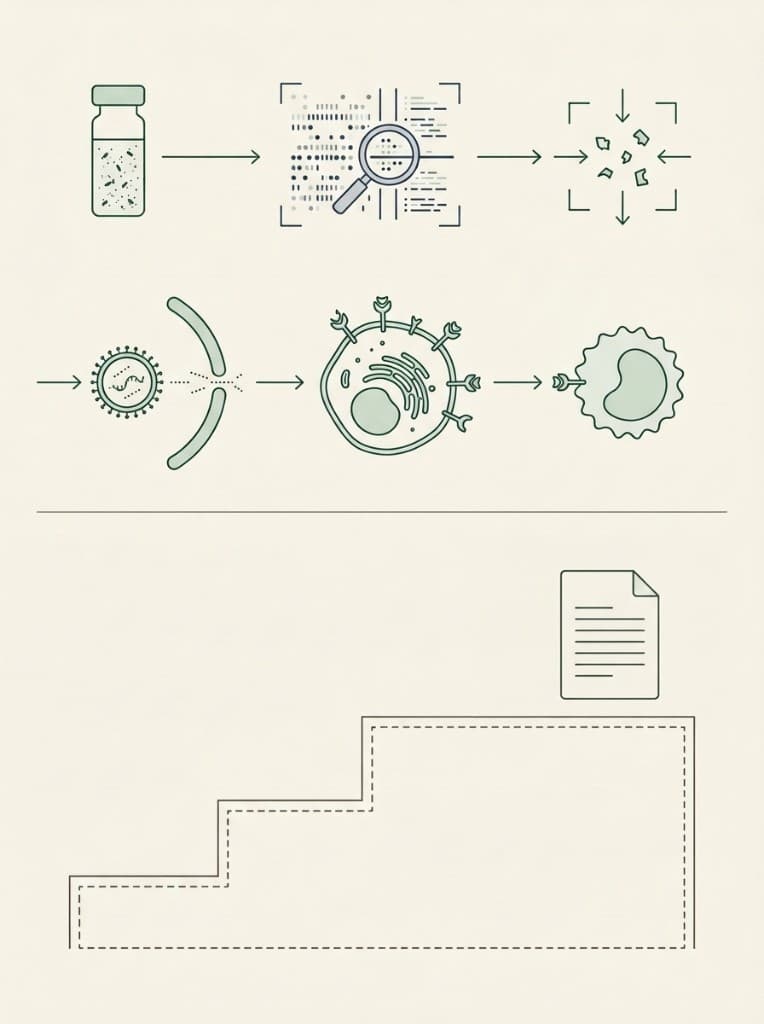
The diagram illustrates one individualised neoantigen mRNA vaccine approach, from tumour analysis and vaccine design to antigen presentation and immune recognition. Other mRNA cancer vaccine strategies also exist. The vaccine is designed to help the immune system recognise selected tumour-associated targets. Actual immune responses and clinical outcomes vary.
Regulatory development
The staircase illustrates regulatory development and assessment. It does not indicate that approval has been granted or that approval is guaranteed. Regulatory approval and treatment availability are separate considerations.
Personalized neoantigen approaches
Some programmes sequence a patient’s tumour to identify mutations that create neoantigens — targets that may be more specific to that tumour — and then design an individualised mRNA construct. Manufacturing time, tissue requirements, and eligibility are protocol-specific.
Individualised design does not, by itself, establish clinical benefit. Those questions are answered, if at all, in properly conducted studies.
Preventive vaccines and therapeutic cancer vaccines
Preventive vaccines (for example those used against certain viruses) are given to people who do not have the disease the vaccine is meant to prevent. Therapeutic cancer vaccines are studied as treatment after cancer is present. The two should not be compared as if they were the same product class.
Public familiarity with mRNA infectious-disease vaccines does not mean that mRNA cancer programmes share the same regulatory status, evidence, or access. All mRNA cancer applications remain investigational.
Programmes in China
China has publicly discussed research activity in mRNA and related oncology technologies. Any named sponsor, hospital, trial or enrolment status appears on this site only with a registry identifier — ClinicalTrials.gov or ChiCTR — and none is named on this page.
Vitanthor does not present that research activity as a commercial offering, and we do not describe any organisation as our partner.
Clinical-trial participation
If a relevant trial exists, participation depends on the protocol: diagnosis, stage, prior therapy, laboratory values, and often the ability to travel and remain for visits. Screening can conclude that a person is not eligible. That conclusion is a medical and protocol decision made by the trial team, not a judgement about the value of the person or the disease.
Vitanthor does not run a trial-matching engine on this website. We can help a family organise records so that an institution can consider whether a study — or another pathway — is appropriate to discuss.
Eligibility review
Vitanthor does not determine eligibility for an mRNA programme. Patient-specific questions belong in a Case Review, which is designed to reach a qualified team rather than to produce an automated answer.
Questions to ask
- 1
Is this programme an approved treatment, a clinical trial, or preclinical research? Ask which of the three it is before anything else. Approved means a regulator authorised the product for a defined indication; a clinical trial is a research study with inclusion and exclusion criteria; preclinical work has not yet been tested in people. Until a named product, regulator and primary source appear, assume investigational or earlier status.
- 2
What is the trial identifier, if any, and which registry is it on — ClinicalTrials.gov, ChiCTR or another? Ask for the identifier and the registry. Both ClinicalTrials.gov and ChiCTR are WHO primary registries or data providers, and China-based sponsors register on either; the identifier lets you check the record yourself. Remember that a registry’s “recruiting” status describes the study as a whole and does not mean a particular site is open to you, least of all as an overseas applicant.
- 3
How does this differ from the preventive mRNA vaccines I have heard about? Preventive vaccines are given to people who do not have the disease; therapeutic cancer vaccines are given after cancer is present to help the immune system recognise it. Public familiarity with mRNA vaccines used against infections such as COVID-19 does not give cancer programmes the same regulatory status or evidence. All mRNA cancer applications remain investigational.
- 4
What tissue or sequencing is required for a personalised construct, and how long does manufacturing take? Personalised mRNA vaccines start by sequencing the tumour to predict neoantigens — abnormal proteins unique to that cancer — and encoding a selected set of them, typically around 15 to 34. Manufacturing takes roughly one to two months, and the tissue required, dose and schedule are specific to each protocol. Individualised design does not by itself establish clinical benefit.
- 5
What happens if I am not eligible after screening? Screening can conclude that a person is not eligible, and that conclusion is a medical and protocol decision made by the trial team, not a judgement about the value of the person or the disease. Ask beforehand what screening involves, what it costs, how long it takes and what happens to your records if you are not enrolled. Vitanthor does not determine eligibility.
- 6
Who is the responsible investigator, and how will my home team be updated? Ask for the named principal investigator and for how your home team will receive updates — in what format, how often, and with your consent. The trial’s investigator and research team, not a coordinator or an agency, make the study’s decisions about your care.
- 7
Has any mRNA cancer vaccine been approved — in China, the US or the EU? No. As of 9 October 2026 no mRNA cancer vaccine is approved for cancer in the United States, the European Union or China; candidates remain investigational, and the Chinese candidates we could check are in early-phase trials. If an approval is ever granted, it will be listed here with its regulator, indication and primary source.
Sources & References
- Cancer mRNA vaccines: clinical advances and future opportunities — preventive mRNA vaccines (such as COVID-19 vaccines) are given before disease, while therapeutic cancer vaccines are given after cancer is present; no mRNA-based cancer vaccine has received regulatory approval — Nature Reviews Clinical Oncology — 2024 — link.
- mRNA-based personalised cancer vaccine (mRNA-4157/intismeran) — NCI Drug Dictionary: the mRNA is taken up by antigen-presenting cells and translated; the expressed epitopes are presented via MHC molecules, inducing cytotoxic T-lymphocyte and memory T-cell responses against the patient's cancer cells — National Cancer Institute (NIH) — NCI Drug Dictionary — link.
- Intismeran autogene (V940/mRNA-4157) individualised neoantigen therapy — up to 34 neoantigens selected from a patient's tumour mutation profile; manufacture to delivery to the clinic site approximately 6 weeks in the trial setting (other platforms encode up to 15–20 neoantigens with similar multi-week manufacture) — JCO Oncology Advances (peer-reviewed, open access) — 2026 — link.
- China's NMPA has granted investigational (IND, clinical-trial) approvals to mRNA cancer vaccines — for example EVM14, an off-the-shelf tumour-associated-antigen mRNA vaccine (October 2025) — while marketing approval has not been granted; China's ChiCTR is a WHO ICTRP primary registry for trial registration — Everest Medicines announcement (October 2025); WHO International Clinical Trials Registry Platform — 2025 — link.
If this category is relevant to the case, start with a review — not an assumption.
Request a Case Review so that records, not a website, inform the next conversation. Vitanthor will not tell you that an mRNA programme is available for a given person.